
Help us find the chrysalises
They're the hardest thing to find and the easiest to lose. Tell us where you saw one and we'll come look. A photo helps and fills the location in by itself, wherever your phone recorded it, but a description of the spot is genuinely enough. Both get acted on.
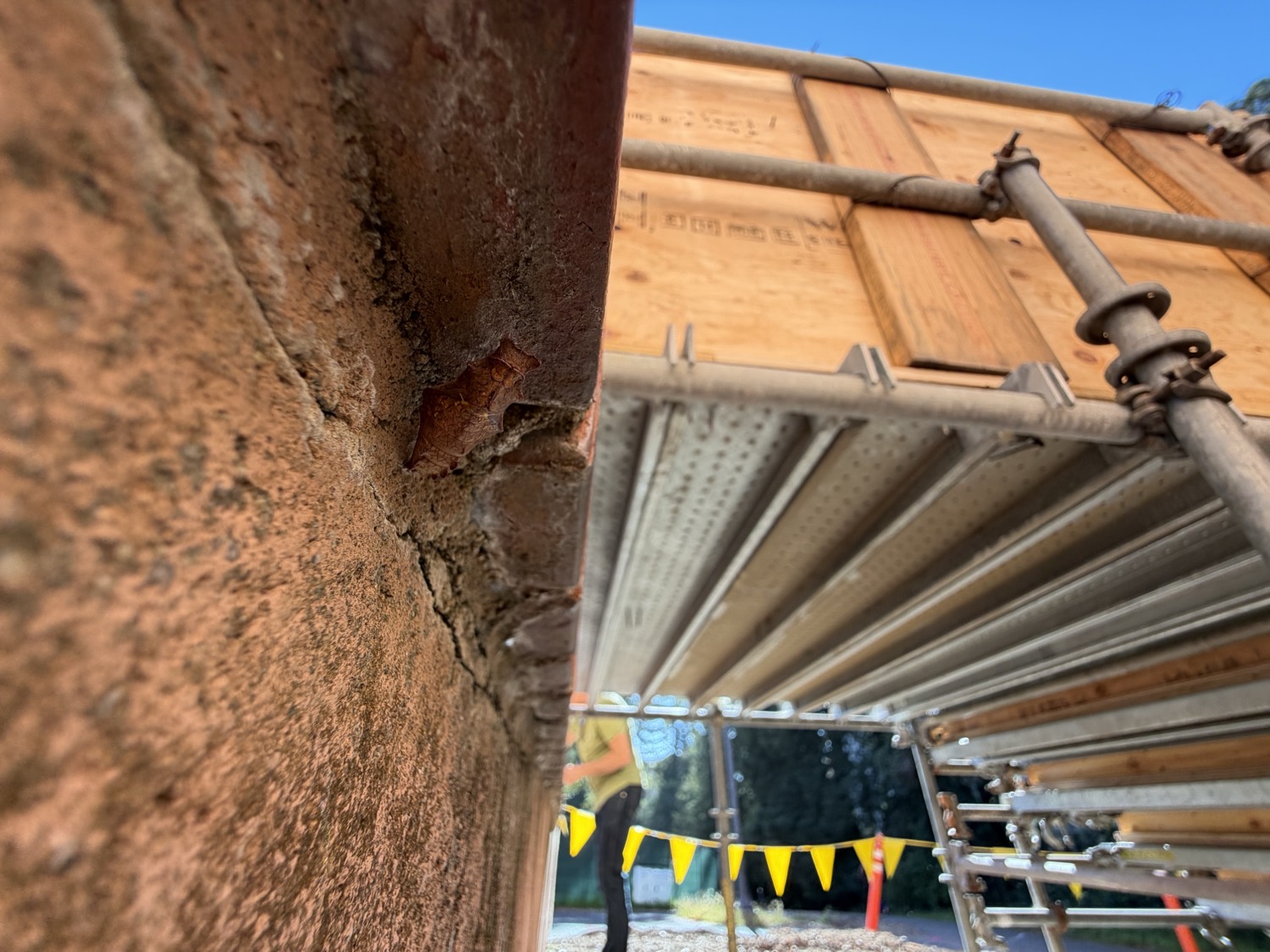
Why chrysalises, and why "could you reach it"
Caterpillars leave the pipevine to pupate, wandering a random distance in a random direction before attaching themselves. So they end up on fence rails, brickwork, scaffolding, the underside of a table lip, or down in the leaf litter. Never reliably on the plant you'd think to search. And the pupa is camouflaged as a curled dead leaf. There is no way to survey for them systematically. It takes a lot of people looking at things that aren't the vine.
The timing is what makes it urgent. A caterpillar that pupates late in the season overwinters as a chrysalis and doesn't emerge until spring, so one attached to a fence in October is still attached to that fence in December and January, which is exactly when ground disturbance is expected.
That's why the form asks whether you could reach it from the ground. One within reach could potentially be moved to safety on its substrate before excavation. One fifteen feet up a wall can only be flagged for avoidance. Sorting those two cases is the difference between a list we can act on and a list we can only worry about.
Please photograph, don't touch
Handling a pupa can kill it, and moving it destroys the record of where it was found. Any relocation is ours to do, with campus permission. Take the picture, note the spot, walk on. Same for caterpillars and the plants themselves.
Report a sighting
Nothing here is required except telling us roughly where it was. If you have a photo it saves you typing; if you don't, describe the spot and we'll find it.
What to photograph
- Chrysalises are the most valuable by far. Not on the plant: check fence rails, brickwork, scaffolding, the undersides of ledges, and leaf litter. Brown, ridged, shaped like a curled dead leaf.
- Caterpillars on the pipevine: the reddish-black larvae with orange spots.
- Adult butterflies nectaring or flying near the creek.
- Pipevine plants: the vine, the pipe-shaped flowers, the leaves.
- Eggs, if you spot them.
- A wide shot showing where the plant grows along the bank.
- Construction disturbance: fresh digging, equipment, or ground markings.
Tips that make your photos count
- Upload the original from your camera roll, not a screenshot or a texted copy. Screenshots and messaging apps strip the hidden location and time.
- If you see several, say roughly how many.
- Take a few angles. Clear photos help confirm the species.
- Observe from the path, and don't handle anything.
Prefer email? Send photos, the date, and where you took them to hello@whrfund.org.