
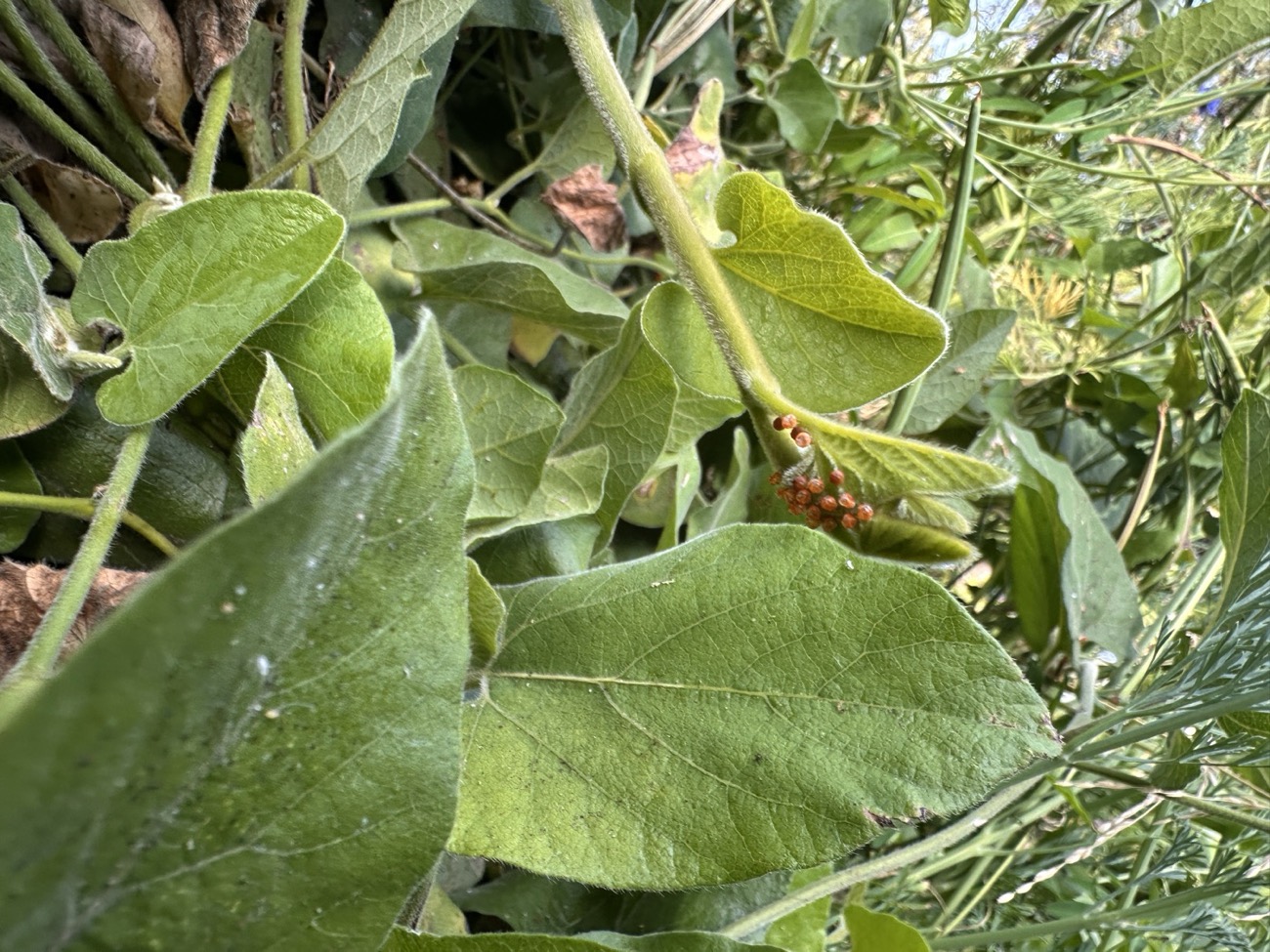
The California pipevine, Aristolochia californica, is a deciduous climbing vine native to Northern California. It is best known for two things: its unusual, pipe-shaped flowers, and its role as the one and only host plant of the California pipevine swallowtail butterfly. Where the pipevine goes, the butterfly follows. Where it disappears, the butterfly cannot survive.
What it is
California pipevine is a woody, twining vine that climbs over shrubs and small trees along streams and in shaded woodland. In late winter and early spring, before the leaves fully emerge, it produces curved, U-shaped flowers, purple-veined and cream colored, that give the plant its common names pipevine and Dutchman’s pipe. Soft, heart-shaped leaves follow, and the vine fills out through spring before dropping its leaves and going dormant through the dry summer and fall.
The host-plant relationship
The plant contains aristolochic acids, compounds that are toxic to most animals. The pipevine swallowtail has turned that toxicity into a defense: its caterpillars feed only on Aristolochia, storing the plant’s chemicals in their bodies so that both they and the adult butterflies they become are distasteful to predators. Because the butterfly’s larvae can eat nothing else, the plant and the insect are ecologically inseparable.
Where it grows
Aristolochia californica is endemic to California, found in the Coast Ranges, the Sacramento Valley, the San Francisco Bay Area, and the Sierra Nevada foothills, almost always in riparian woodland near creeks and seeps. It favors cool, shaded soil for its roots and tolerates the seasonal wet of streamside habitat.
Identifying it
Look for a climbing vine with heart-shaped leaves along creeks and shaded slopes. In late winter, the small, curved, pipe-shaped flowers are unmistakable. By mid to late summer the leaves yellow and drop as the vine enters dormancy, which is also the season it is most fragile to disturb.
Growing it in your garden
Pipevine is an easy plant in the right spot and a sulky one in the wrong spot, and the difference is mostly shade and water.
- Light: dappled shade to part sun. It scorches in full afternoon sun.
- Water: regular water for the first year or two while it establishes, then largely self-sufficient.
- Support: a trellis, fence, shrub, or low tree to climb.
- Soil: it evolved in creek corridors and shaded oak woodland, so cool, deep soil suits it best.
- Patience: it may sulk the first season while it puts down roots. That is normal.
A note on safety: pipevine contains aristolochic acids, which is exactly what makes the swallowtail caterpillars poisonous to predators. It is a butterfly host plant, not a herb. Do not eat it, and site it accordingly if you have small children or curious pets.
What a dormant plant looks like
If you collect a rescued pipevine in autumn, it will most likely look like bare stems in a pot. That is a healthy dormant plant, not a dead one. California pipevine drops its leaves and goes dormant through the dry season; it leafs out and opens its strange, pipe-shaped flowers in late winter. The ideal planting window is November through February, so a plant collected in October can be kept potted and watered until you are ready for it.
Reserve a free rescued pipevine →
Why it is at risk at UC Berkeley
A long-established pipevine patch along Strawberry Creek at UC Berkeley supports a thriving population of pipevine swallowtails, but it sits in the path of a major campus utility project. Learn more on our Save the Pipevine page.
How you can help
Document pipevine and butterflies you find, share photos and observations, volunteer for habitat restoration, and support new native pipevine plantings across Berkeley. To get involved, contact us at hello@whrfund.org.
Support this work. Your donation funds habitat restoration and native pipevine plantings across Berkeley, and every gift comes with a thank-you sticker. Make a donation →