
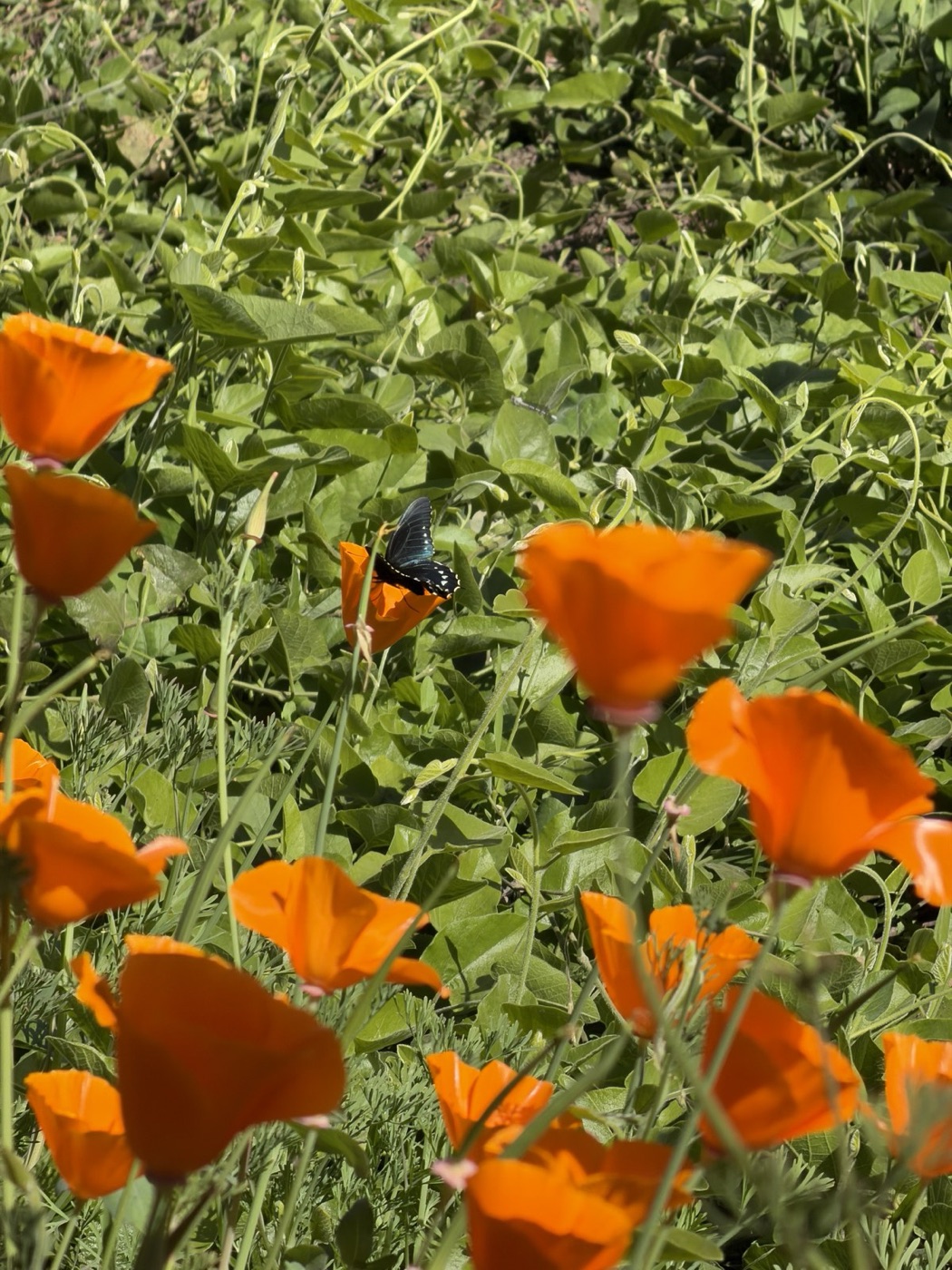
The California pipevine swallowtail, Battus philenor hirsuta, is a striking black-and-iridescent-blue butterfly found in Northern California. It is the California subspecies of the wider pipevine swallowtail, distinguished in part by its hairier body, and it lives its entire life tied to a single plant: the California pipevine.
The butterfly
Adults are dark butterflies with shimmering blue to blue-green hindwings, most vivid in males, and a row of bright orange spots on the underside of the hindwing. Their toxicity makes them a model that several other California butterflies mimic for protection. Because adults range widely and fly fast, they are difficult to count reliably in the field.
An obligate relationship with pipevine
The pipevine swallowtail is an obligate specialist. Its caterpillars can feed on nothing but Aristolochia, and in California that means Aristolochia californica, the California pipevine. The butterfly cannot reproduce without it. If a local pipevine patch is lost, the butterflies that depend on it are lost with it, which is why protecting established host-plant habitat is so important.
The life cycle
Four stages, and the words matter: egg, caterpillar, chrysalis, butterfly. Butterflies form a chrysalis. A cocoon is a moth’s, spun from silk.
Egg. The female lays small, bright orange eggs in clusters, usually on the tender new growth of the vine. Before she lays, she tastes the plant with her feet. Butterflies carry chemical receptors on their tarsi, the segments of the leg that touch down first, and a female drums her forelegs against a leaf to check she has found the right plant before committing her eggs to it.
Caterpillar. The caterpillar grows through five instars, shedding its skin between each one and changing color and pattern as it goes. Young ones are orange-red and feed together in a group; later instars are near black with rows of orange projections, and feed alone. Throughout, they eat California pipevine and nothing else. The vine’s aristolochic acids pass into the caterpillar and stay there for the rest of its life, which is what makes both the caterpillar and the adult butterfly distasteful to birds. The bold coloring is the advertisement for it.
Chrysalis. The caterpillar spins a small pad of silk, then a silk girdle across its middle, and fastens itself to a stem, a wall or a fence before it pupates. The chrysalis is green or brown rather than the bright color people expect, and which one it turns out to be depends on the surface it chose and on the length of the day: smooth surfaces tend to produce green, rough ones brown, and shortening days override both and produce a brown, overwintering chrysalis. In warm months the butterfly ecloses in roughly two weeks.
Butterfly. In California the species passes the winter as a chrysalis, which is why adults are on the wing in March, before the bare pipevine has put out a single leaf. The butterflies arrive before their plant does, and wait for it.
One thing worth knowing if you are keeping a chrysalis: an overwintering chrysalis does not have to emerge the following spring. Some wait three or four years before the butterfly comes out, holding in diapause against a bad season. A quiet chrysalis is not a dead chrysalis. Do not throw it away.
Caterpillars, and how we count them
The caterpillars are dark, almost black, lined with rows of orange or red projections, and are often found feeding together on the vine. Like the adults, they store the pipevine’s aristolochic acids and are distasteful to predators. Because adult butterflies cannot be reliably counted, surveyors census the caterpillars on the host plant instead. The presence of caterpillars feeding on pipevine is direct evidence of active, on-site breeding. Recent counts at the UC Berkeley patch recorded between 1,000 and 2,000 caterpillars in peak months.
Range and the Bay Area populations
The pipevine swallowtail occurs wherever its host plant grows in Northern California. In the San Francisco Bay Area, important populations cluster at a handful of sites, which makes each established patch valuable.
The UC Berkeley habitat
One of those established breeding sites, along Strawberry Creek on the UC Berkeley campus, is threatened by a major utility project. Read the full story and how to act on our Save the Pipevine page.
How you can help
Photograph and report adults, caterpillars, and pipevine plants you find, share your observations with us, volunteer for habitat restoration, and support new pipevine plantings across Berkeley. To get involved, contact us at hello@whrfund.org.
Support this work. Help us protect breeding habitat and plant more pipevine across Berkeley, and every donation comes with a thank-you sticker. Make a donation →