
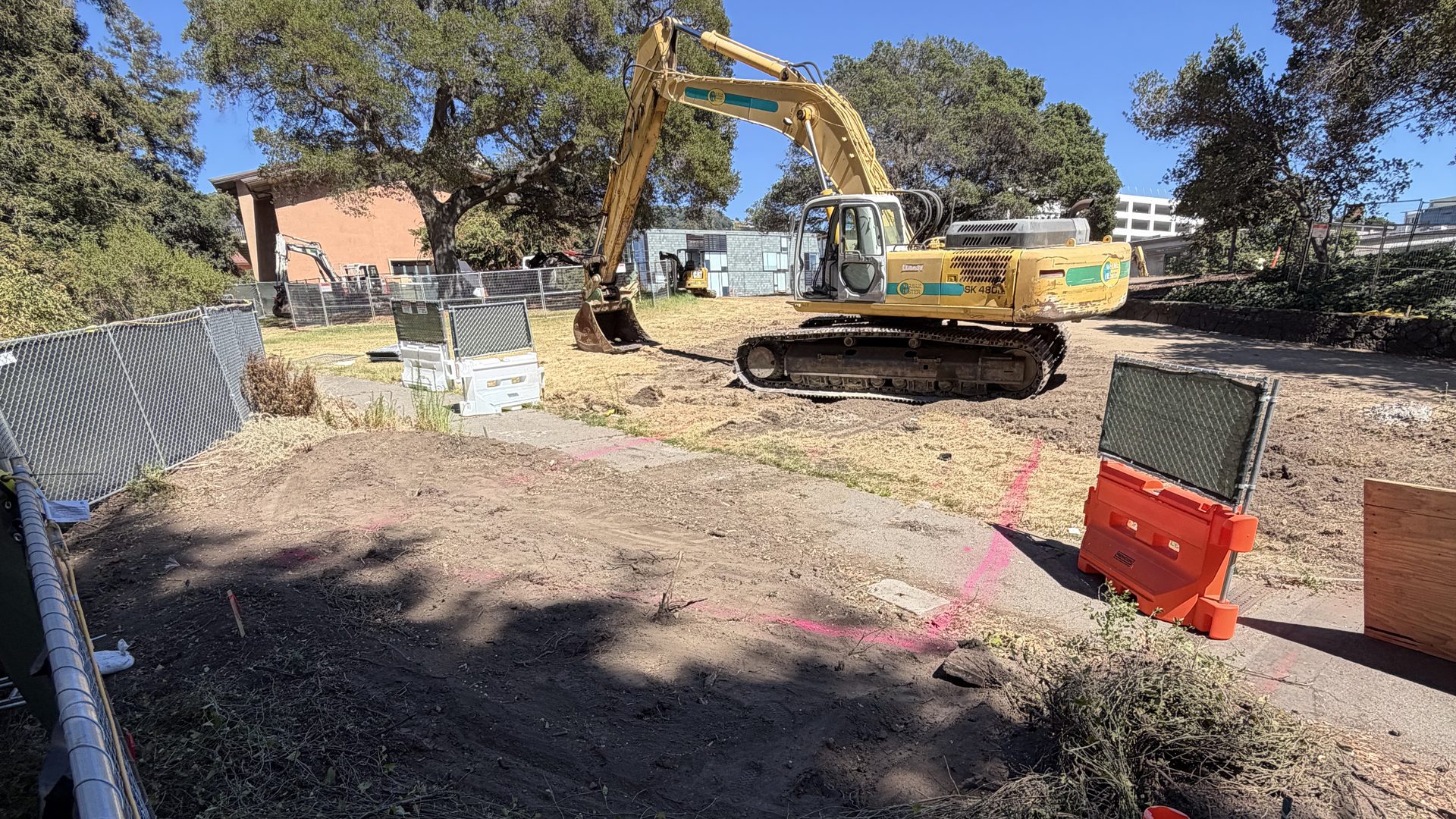
On Friday, July 24, 2026, an excavator was working at the California pipevine (Aristolochia californica) patch along Strawberry Creek on the UC Berkeley campus. The vines have been cut. The ground has been cleared and graded.
This was the largest and most productive breeding population of the California pipevine swallowtail (Battus philenor hirsuta) we know of in the Bay Area. In peak months, counts at the site have recorded 1,000 to 2,000 caterpillars. Pipevine is the only plant this butterfly can breed on. Not its preferred plant, its only one.
Aired on CBS News, and torn up the next day
On Thursday, July 23, CBS News Bay Area published Molly McCrea’s report on this habitat. You can read the story and watch the segment. I am grateful to her for telling it with care.
In the piece, a University spokesperson said, “We regret that this project is going to disturb the area a little bit. We want to disturb it as little as possible,” and, “We greatly value the caterpillars, the butterflies, and the people who have been tending them.”
The clearing happened the following day.
That segment is now a public record that this habitat existed, that it was alive and that people loved it, at the very moment the University began pulling it out of the ground.
The habitat they never put on the record
Here is the part that matters most, and the part that is easiest to miss.
The project’s environmental review, Addendum #8 to the University’s 2021 Long Range Development Plan EIR, never identifies or analyzes the pipevine or the swallowtail anywhere in its biological resources section. It nonetheless concludes that there are no new significant biological impacts.
A living, breeding habitat, never once named in the environmental review that cleared the work.
When a living resource is left off the record, it becomes far easier to erase. We formally asked the University to survey the habitat and complete proper environmental review before any ground disturbance, and to route the project’s utilities around the patch rather than through it. Neither the plant nor the butterfly is listed under the state or federal Endangered Species Acts, so every protection here was voluntary.
A promise they are not keeping
On its website, UC Berkeley published a voluntary Pipevine Preservation and Replanting Strategy, promising to carefully transplant the vines and even expand the habitat once construction is finished. We want that to be true.
It is not what is happening on the ground. California pipevine has a deep, widespread root system. To survive a move it has to be lifted while dormant, roots intact, in late fall or winter around the first rains. What we are seeing instead are vines pulled from the soil in summer, without their roots. A pipevine taken up that way cannot be transplanted. It does not come back.
There is one more detail in the photograph above worth naming. The pink utility marking paint crossing the cleared soil is the same line we described in our response to the replanting plan in June, sprayed through the densest and most established rooting of the patch rather than along a narrow edge. The excavation followed it.
A habitat left off the environmental record. A public promise that the work on the ground does not match. A University that told us it would coordinate, and then stopped answering.
One hundred chrysalides
At a volunteer event on July 17, we carefully gathered 100 pipevine swallowtail chrysalides out of the construction zone.
They were in real danger where we found them. Pipevine swallowtails do not pupate on the vine. When a caterpillar is ready, it wanders away from its host plant and attaches somewhere else entirely, and the chrysalis it forms is camouflaged as a curled dead leaf. At this site, many were fixed directly to temporary construction fencing, the kind that gets moved again and again as work proceeds. Some had already been crushed in the course of shifting that fencing.
A chrysalis can wait a remarkably long time before the butterfly emerges, in some cases years. But when these do eclose, there may be no habitat left for the adults to lay their eggs in, and no host plant for the caterpillars that would follow.
We are holding these hundred lives, and doing everything we can to make sure there is somewhere for them to return to.
This is also why the University’s commitment to time its work “outside of the window when caterpillars are nesting” does not cover what was actually on this ground. Caterpillars on a vine can be seen and avoided. Overwintering pupae attached to a fence are motionless, invisible, and present straight through the construction season.
A butterfly with nowhere to go
I watched a swallowtail return to the site and search, and search, for somewhere to lay her eggs. She found nothing, because her host plant is gone.
A butterfly cannot improvise. She lays only on the tender new stems of this one vine, and her caterpillars eat nothing else. Without the pipevine, there is no next generation here.
Hold them to their word
We asked the University to pause and do this carefully, and we laid out the gaps in their plan. They are not working with us, and the digging has begun. So the fight now is to hold them to their own public promise.
On their website, the University committed to increasing pipevine habitat across campus. There is a real way to make that true. The campus is blanketed in English ivy, kept for an old world aesthetic even though it is one of the most invasive plants here. Replace that ivy with California pipevine, and this project could end with more habitat than it started with, not less.
That is the outcome worth fighting for. Without steady pressure, the only outcome is habitat destroyed and then built over.
Concretely, we are still asking for four things:
- Publish the site list. The replanting plan says viable areas along Strawberry Creek are being identified with experts. That list has never been made public, and no one has communicated it to us.
- Transplant in the dormant season, roughly November through February, with roots intact.
- Survey before any further disturbance, including for overwintering chrysalides on structures, not only for caterpillars on vines.
- Commit to numbers and monitoring. How many vines, planted where, measured how, reported when, and for how many years.
How you can help today
There are hands on ways to help right now.
Start a pipevine propagation in your own garden. We are also looking for a place to house and water many young propagations through the coming months until they can go in the ground this winter, and for spots where we can plant them. If you have a garden, some land, or a lead, tell us where you think pipevine should go or email hello@whrfund.org. We also have rescued plants to give away, rooted and growing in one-gallon containers. Reserve one now and collect it at our weekly potting evenings, 5:30 to 7:30pm, at 3062 California St, Oakland. Plant it once the rains start, roughly November through February: a native that goes in as the storms arrive establishes far better than one put into dry ground. If you collect early, keep it potted, shaded and watered until then.
A short, polite note to UC Berkeley’s Chancellor’s Office still carries weight. Here is what to ask for and who to send it to.
The butterfly disappeared from much of the urban East Bay about three decades ago, and it came back because people planted for it, in parks and in their own yards. That is the same work, and it is still available to us.
Thank you for standing with these butterflies.